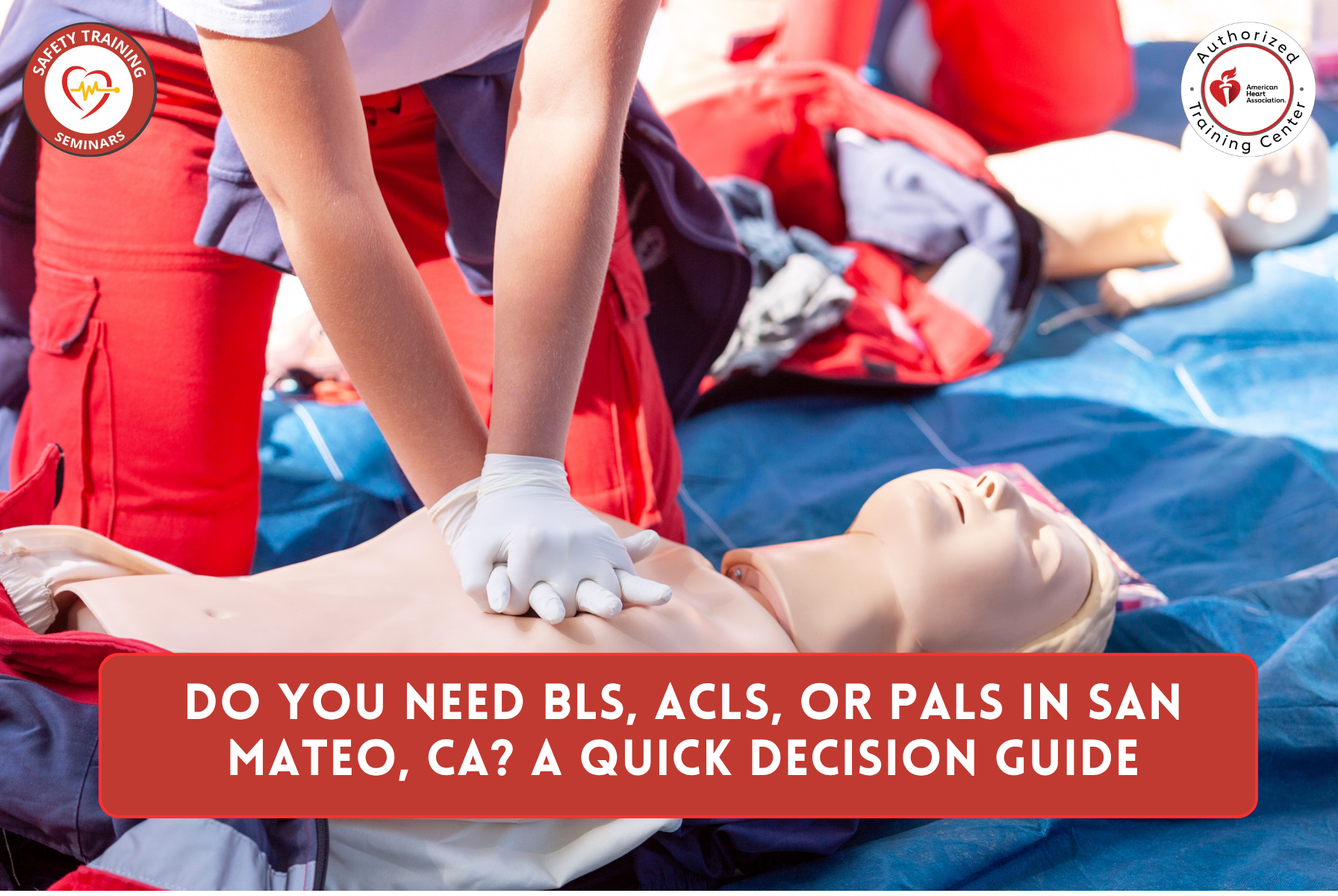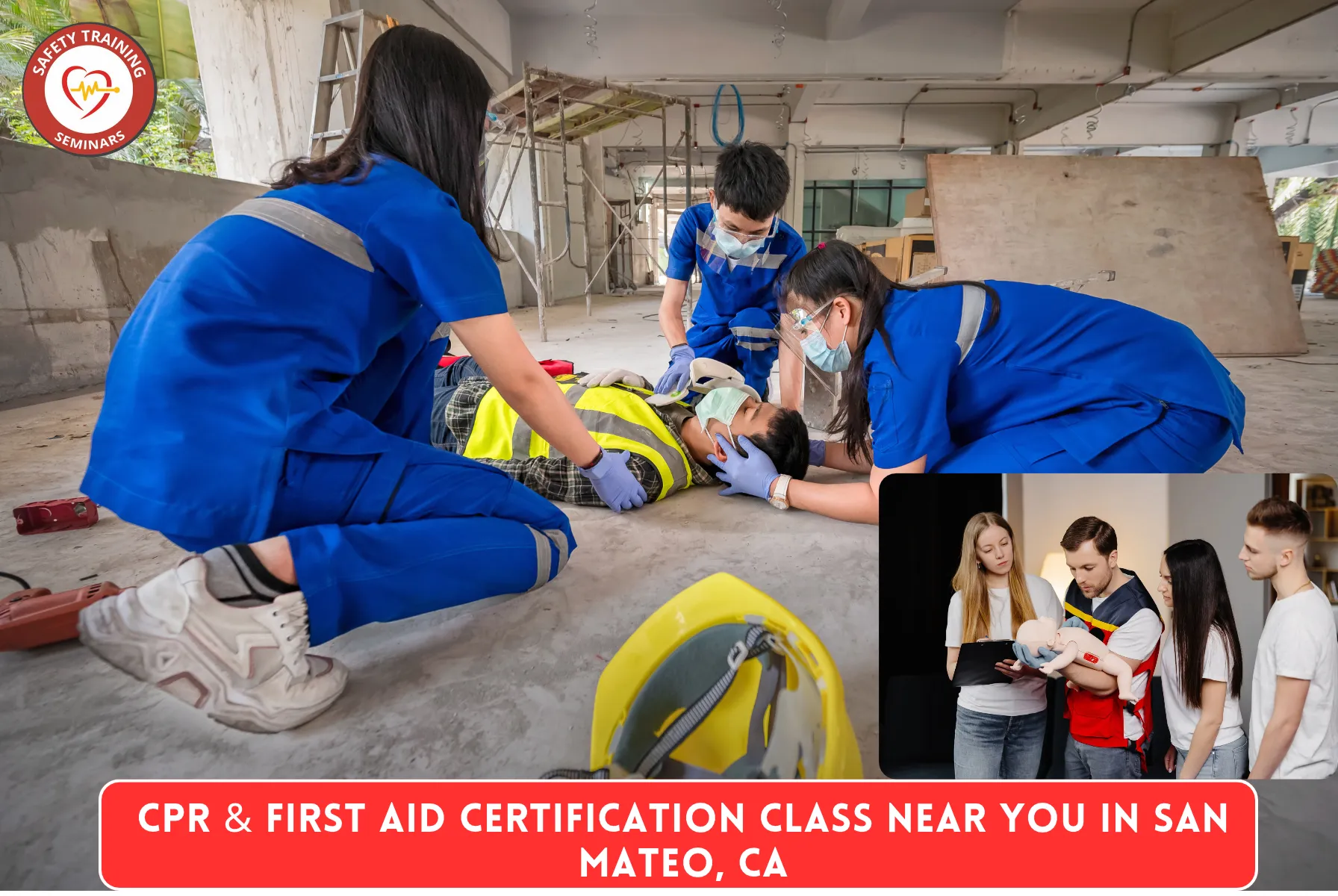
It’s possible that a preschool teacher in the Hillsdale neighborhood, a front-desk coordinator at a downtown office, a parent who spends Saturdays at the playground in Central Park, and a gym coach in the Bay Meadows neighborhood all have very little in common with one another in terms of their professional lives. But each of them has the potential to be the closest adult in the event that someone passes out, chokes, or sustains serious injuries. People without a clinical background who wish or are forced to act confidently in the minutes before paramedics arrive are the target audience for a CPR and First Aid certification class. This is the particular audience that a class is designed to serve.
This guide explains what the course teaches, how it differs from healthcare-provider training such as BLS, which San Mateo settings tend to ask for it, and how to choose and register for a CPR & First Aid certification class in San Mateo that matches your actual requirements.
What You Actually Practice in a CPR & First Aid Course
The American Heart Association’s version of this training is called Heartsaver First Aid CPR AED. According to the AHA, it is intended for people with little or no medical training who need a course completion card for a job, a regulatory requirement such as OSHA, or simply personal preparedness.
The course combines two skill sets that are often taught separately:
- CPR and AED use. Recognizing cardiac arrest, calling for help, delivering high-quality chest compressions and breaths, and operating an automated external defibrillator (AED), the portable device that analyzes heart rhythm and can deliver a shock.
- First Aid. Responding to bleeding, burns, sprains and suspected broken bones, shock, allergic reactions, heat and cold emergencies, and sudden illnesses such as signs of heart attack or stroke.
- Choking response. Relieving airway obstruction in a responsive person.
- Child and infant modules. The AHA offers course paths that add child and infant CPR, which matters for parents, coaches, and anyone working with young people.
Cardiopulmonary resuscitation, sometimes known as CPR, is a technique that helps maintain the flow of oxygen-rich blood to the brain and heart even after the heart has ceased pumping properly. First aid encompasses a considerably wider range of injuries and diseases than cardiac arrest, but requires a calm and appropriate approach regardless of the nature of the injury or sickness.
Every AHA Heartsaver path ends with a hands-on skills session, where learners practice on manikins and demonstrate competency. Watching videos alone does not complete the course.
Where San Mateo Residents Put These Skills to Use
San Mateo sits in the middle of the Peninsula, bordered by Burlingame and Hillsborough to the north, Belmont to the south, and Foster City across Highway 101. That mix of family neighborhoods, office corridors, schools, and healthcare facilities means CPR and First Aid knowledge is relevant in very different settings.
Childcare centers and preschools
Childcare is the setting where requirements are most specific. California’s Emergency Medical Services Authority (EMSA) states that child care provider training includes 4 hours of Pediatric First Aid and 4 hours of Pediatric CPR/AED, and that both must be repeated every two years. First-time licensees also complete 8 hours of Preventive Health and Safety training.
EMSA confirms that pediatric First Aid and CPR training from the American Heart Association is acceptable. The key point for San Mateo childcare staff is that a general adult-focused course may not satisfy licensing. Choose the pediatric childcare version when your role falls under Community Care Licensing.
Offices, retail, and other workplaces
Cal/OSHA’s General Industry Safety Orders, Title 8 Section 3400, require that when no infirmary, clinic, or hospital is in near proximity for treating injured employees, one or more people must be adequately trained to render first aid. How that applies depends on the specific workplace, so safety coordinators should confirm their obligations directly with Cal/OSHA guidance. Even where the rule is not triggered, a trained responder on each floor or shift is a sensible part of workplace emergency preparedness.
Homes, parks, and youth activities
In most cases, there is no rule that specifically applies to parents, grandparents, babysitters, and youth coaches; yet, the stakes are quite personal. Anyone who is responsible for the care of young children at home, in Central Park, or along the seashore of Coyote Point should consider enrolling in a course that teaches cardiopulmonary resuscitation (CPR) for children and infants.
Patient-facing roles in a regional healthcare hub
San Mateo is home to San Mateo Medical Center, the county’s public hospital, which operates a 24-hour emergency department on West 39th Avenue. Mills-Peninsula Medical Center sits just north in Burlingame. The College of San Mateo nursing program on West Hillsdale Boulevard notes that students learn in local hospitals and community health agencies.
This is where many people pick the wrong course. Nurses, nursing students, medical assistants, dental teams, and other clinical staff are typically expected to hold healthcare-provider BLS, not Heartsaver CPR & First Aid. Always check your employer’s or program’s written requirement before enrolling.
Heartsaver, BLS, ACLS, or PALS: Matching the Course to Your Role
The AHA designs each course for a different responder. Heartsaver CPR & First Aid is for lay responders; BLS, ACLS, and PALS are healthcare-provider courses with progressively more clinical content.
| Course | Designed for | Core focus | Typical San Mateo learners |
| Heartsaver First Aid CPR AED | People with little or no medical training | CPR, AED, choking, and common First Aid emergencies | Office staff, teachers, coaches, parents, fitness instructors |
| Pediatric First Aid CPR AED (childcare) | California childcare providers | Child and infant emergencies plus pediatric First Aid | Preschool and daycare staff, family childcare operators |
| BLS (Basic Life Support) | Healthcare professionals and students | High-quality CPR, team resuscitation, bag-mask ventilation | Nurses, nursing students, MAs, dental teams, EMTs |
| ACLS | Advanced clinical providers | Cardiac arrest algorithms, rhythms, pharmacology | Emergency, ICU, and telemetry clinicians |
| PALS | Clinicians treating children | Pediatric assessment and advanced resuscitation | Pediatric, emergency, and critical care staff |
One rule of thumb helps: if you provide patient care, start by confirming whether BLS is required. If you do not, Heartsaver CPR & First Aid is usually the right fit, unless you work in licensed childcare.
Five Questions to Answer Before You Register
A few minutes of checking prevents the most common problem: completing a course, then learning it was not the one your employer or licensing agency wanted.
- Who is asking for the training? Find the written requirement from your employer, school, licensing agency, or volunteer organization. Note the exact course name if one is listed.
- Which age groups do you need? Adult-only CPR suits some workplaces. Anyone around children should choose a path with child and infant CPR, and childcare staff need the pediatric childcare course.
- Is an AHA course specified? Many organizations name the American Heart Association. If yours does, confirm the course carries AHA documentation.
- Does the format include hands-on skills? The AHA offers Heartsaver as a full classroom course or as blended learning, where an online module is followed by an in-person skills session. California childcare requirements in particular call for a practical skills component, so fully online options without skills testing are a poor fit.
- What documentation will you receive? Successful completion of AHA Heartsaver First Aid CPR AED results in a course completion card valid for two years, commonly delivered as an AHA Course Completion eCard. It documents course completion; it is not a professional license, and acceptance is always decided by the organization requesting it.
Putting a renewal reminder on your calendar a couple of months before the two-year mark keeps you from scrambling when a job or licensing review comes up.
Training with Safety Training Seminars on Peninsula Avenue
Safety Training Seminars runs an American Heart Association training location in San Mateo at 428 Peninsula Ave., Suite B, San Mateo, CA 94401, near the city’s northern edge by Burlingame. That makes it a practical option for learners coming from Burlingame, Hillsborough, Foster City, Belmont, and Millbrae as well as San Mateo itself.
The San Mateo location lists the following AHA programs:
- Heartsaver CPR & First Aid for the general public, workplaces, and schools
- Pediatric CPR & First Aid for California childcare providers
- BLS for healthcare professionals and students
- ACLS and PALS for advanced clinical roles
- Renewal courses for learners whose AHA cards are nearing expiration
If you are unsure which of these matches your situation, use the five questions above, then compare them against the course descriptions on the San Mateo CPR & First Aid certification course page.
How registration works
- Review the course page for current dates, formats, and pricing, since schedules change.
- Select the course that matches your written requirement, not just the shortest option.
- If you choose blended learning, finish the online portion before your skills session and bring proof of completion.
- Wear comfortable clothing; skills practice involves kneeling and compressions on manikins.
- After you pass the skills check, watch your email for your AHA Course Completion eCard.
Frequently Asked Questions
Is a CPR & First Aid certification class the same as BLS?
No. Heartsaver CPR & First Aid is designed for lay responders and adds First Aid topics. BLS is a healthcare-provider course focused on high-quality CPR, team-based resuscitation, and clinical tools such as bag-mask devices. Nurses and other patient-care staff in San Mateo are usually asked for BLS.
How long is the AHA course completion card valid?
The AHA Heartsaver First Aid CPR AED course completion card is valid for two years. California childcare providers must also repeat pediatric First Aid and CPR every two years, according to EMSA.
Will a standard CPR & First Aid course meet California childcare licensing?
Not necessarily. EMSA describes a specific requirement of 4 hours of pediatric First Aid and 4 hours of pediatric CPR/AED for childcare providers. Choose the pediatric childcare course if you work in a licensed center or family childcare home.
Can I complete the whole course online?
The AHA’s blended option lets you complete the knowledge portion online, but a hands-on skills session is still required to receive an AHA course completion card.
Does my employer have to accept my card?
Acceptance is the employer’s decision. Confirm the required course name and provider with your HR department or safety coordinator before you register.
Do I need CPR & First Aid training if I’m not a healthcare worker?
No law requires most individuals to train. Still, people who care for children, older relatives, or coworkers often find the skills valuable, and many employers and volunteer programs request them.
Ready When It Counts on the Peninsula
Who you are responsible for will determine which CPR and first aid training is most appropriate for you. The AHA Heartsaver CPR & First Aid program is an excellent resource for lay responders in settings such as workplaces, schools, gyms, and homes. The pediatric childcare version is required for licensed adults who work in childcare. It is the responsibility of anyone providing patient care to determine whether or not BLS is necessary instead.
Once you have determined which course is appropriate for you, you should visit the Safety Training Seminars site at 428 Peninsula Avenue, Suite B, to examine the most recent dates and formats, and then make a reservation for a seat in the session that is most convenient for your schedule. It just takes a few hours of practical experience to transform uncertainty into a clear and self-assured reaction the next time someone in the vicinity requires assistance.